"Ellinikos Cosmos" Cultural Centre, the
Foundation of the Hellenic World
Conversion of Viosol Factory
254 Pireos St, Tavros, 1997-1999
Architects
Natalia Efremoglou
Marina Dede
Giorgos Andreadis
This work by architects Natalia Efremoglou, Marina
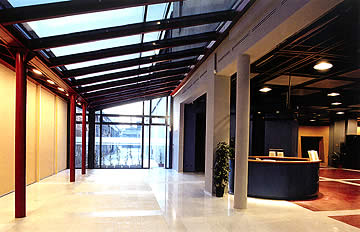
Dede and Giorgos Andreadis is one of the most successful conversions
of industrial buildings in Athens. Part of the former Viosol factory
in Tavros was converted to house the activities of "Ellinikos Cosmos",
the Cultural Centre of the Foundation of the Hellenic World. The conversion
of the building’s ground floor constituted the first phase of the
project, and the enlargement of the upper floor was the second.
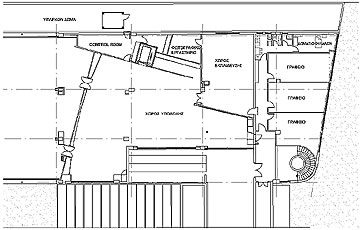
The ground floor, with an area of 2180 sq.m., includes public areas
of about 500 sq.m., an exhibition venue of 880 sq.m. for educational
programmes, a multiple uses hall with seats for 90 persons (168 sq.m.),
a snack bar and Internet café (330 sq.m.) and a service area
of 240 sq.m. Later, part of the building next door, with an area of
280 sq.m. was converted to house two virtual reality facilities.
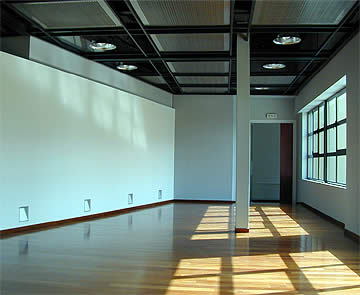
The upper floor, with an area of 1800 sq.m., includes: public area of
260 sq.m., an exhibition venue of 1100 sq.m., a teaching area of 60
sq.m., offices 90 sq.m. and service areas of 82 sq.m.
Before the remodelling, the exhibition venue in building 1 included
a small section for offices on Pireos St, while the main area on the
ground floor and part of the upper floor that had housed the industrial
activities of Viosol was completely deserted.
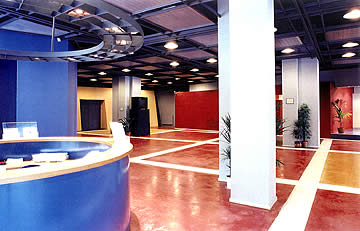
The ground floor of the building - a plain, oblong area with a rectangular
grid of structural pillars - was converted in order to demarcate areas
for the different activities. These areas were sometimes free level
spaces (Internet café, snack bar) and at others closed spaces
(multiple uses hall, service areas). Thus movement was defined within
the shell with interesting optical outlets.
A large part of the upper floor was torn down and rebuilt with visible
metal structural elements. The revelation of this structure both on
the outer façade and in the interior constitutes a basic compositional
principle, while the synthesis follows the main directions of the ground
floor (boundaries between units on a slope with respect to the rectangular
grid, material harmonised with the character of the building).
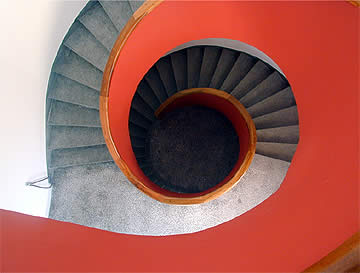
The necessary furnishings were also designed for the new areas (an entrance
bench, shop, computer tables, coffee shop).
TRANSPORTATION