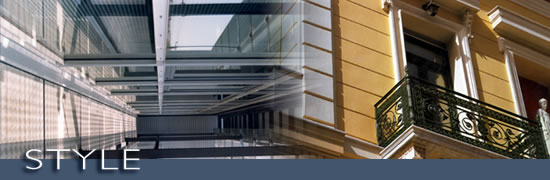
The dominant trend in modern architecture in Athens was an attempt to become aligned with international currents while seeking to bring them in line with local conditions. At its best, this attempt resulted in a creative assimilation, or Hellenization of the prevalent modes: the eclecticism of the École des Beaux Arts of Paris at the end of the 19th century, Art Nouveau and the Jugendstil in the early 20th, Rationalism, modern Classicism and Art Déco during the inter-war years, and finally the dominant trends of international architecture after WWII, i.e. the International Style, Neo-Historicism, Brutalism, Postmodernism, Late Modernism, Deconstructivism and Neo-Modernism. At its worst, we observe the incorrect application of international stylistic codes.
Two specific features distinguish urban architecture in the Greek capital: The heavy legacy of Athenian 19th century Neo-Classicism and the sentimental attachment of its creators to the indigenous vernacular tradition.