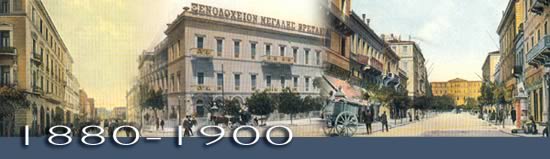
At the end of the 19th century,
Athens, the capital of the Modern Greek state since 1834, would complete
its architectural and urban development, showcasing at the same time its
unparalleled ancient monuments. It had become an attractive city with
idyllic rural areas and remarkable public buildings, erected thanks to
the generosity of the Diaspora Greeks, a city capable of hosting, in 1896,
the first Olympic Games of the modern era. This was the city the 19th
century handed over to the 20th, an Athens with a population of 200,000,
in whose limited boundaries stood buildings no higher than two-, three-storeys,
surrounded by gardens and courtyards.
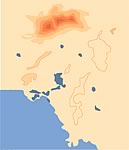
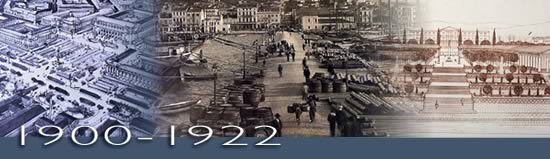
From the dawn of the 20th century
until 1922, when the city reached a population of 500.000, Athens became
the instigator and simultaneously the main recipient of the historic changes
taking place in Greece. The two victorious Balkan Wars of 1912 and 1913,
which almost doubled the territory of the Greek State, the state improvement
projects undertaken by Prime Minister Eleftherios Venizelos, and the introduction
of a multitude of innovations into the everyday life of its inhabitants
would enable the city to draw near its European models. The optimistic
climate of the second decade of the 20th century favored a systematic
attempt to design the capital’s urban space. The cessation of the
unfettered expansion of the city limits, the attempt to formulate an urban
planning strategy for Athens and the 1919 ordinance that facilitated the
erection of multi-storied apartment buildings were characteristic expressions
of a political will aspiring towards a Western style of urbanization.
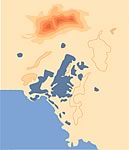
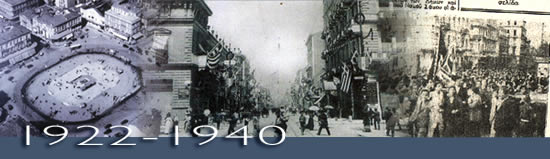
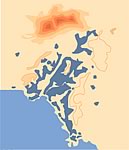
The eighteen years that separated
the 1922 Asia Minor Disaster from World War II comprised one of the most
shattering and contradictory periods of the history of Athens. The city
saw its population increase by 145,5% to reach, in 1940, a total of 1.124.109
inhabitants. The need to confront the very acute problem of housing not
only 230,000 Greek refugees from Asia Minor, but also rural migrants as
well as immigrants, put an end, to all extents and purposes, to the grand
urban plans of the second decade of the 20th century. In spite of the
state’s substantial achievement in organizing refugee and inexpensive
housing, illegal construction outside the city zoning boundaries provided
a solution to the pressing needs of a large portion of less prosperous
migrants. Housing construction for the middle and upper classes was assumed
by the private sector. In the central neighborhoods of Athens a specific
type of urban apartment building became standard and the singular financing
method of giving up one’s property to contractors in exchange for
one or more apartments in the building (antiparochi system) was introduced.
At the same time, the British "garden city" found fertile ground
in the northern and southern suburbs of Athens: Psychico, Filothei, Nea
Smyrni, Palaio Faliro, etc. It was precisely during those same years that
a series of infrastructure and urban development projects -improvements
in transportation, an increase in the number of squares and green areas,
etc.- enhanced the quality of life of Athens’ inhabitants and visitors.
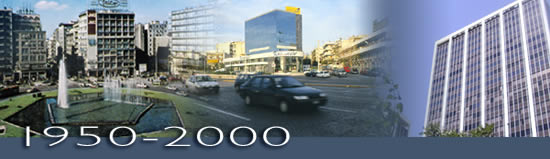
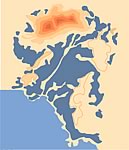
The shadow of the harsh experiences
of the Nazi occupation (1941–44) and the tragedy of the Civil War
(1946–49) that lay over Athens significantly delayed the beginning
of the postwar period. This deviation in both its urban development and
architectural course from that of the other cities of Europe increased
during the period 1950–80. This was mainly due to the city’s
population explosion of 220% and the limited regulatory authority exercised
by the state. Athens was rebuilt through the auspices of the private sector
using the antiparochi system. Neighborhoods were flooded with apartment
buildings and the historic city center was destroyed. With no official
city plan in existence, illegal construction expanded the city.
The demographic stability achieved during the ‘80s and 90s, as well as certain fortuitous coincidences would significantly alter the situation. A positive development, corresponding to international trends, was the restoration of the historic city center, urban renewal, and the restoration and utilization of historic buildings. However, on the debit side, the mass exodus of approximately 3.000.000 Athenians, who suffering from air pollution, abandoned the declining central neighborhoods for the outskirts of the city and the coastal areas, would aggravate the anarchic urban development and the environmental decline of the Athens basin.
The demographic stability achieved during the ‘80s and 90s, as well as certain fortuitous coincidences would significantly alter the situation. A positive development, corresponding to international trends, was the restoration of the historic city center, urban renewal, and the restoration and utilization of historic buildings. However, on the debit side, the mass exodus of approximately 3.000.000 Athenians, who suffering from air pollution, abandoned the declining central neighborhoods for the outskirts of the city and the coastal areas, would aggravate the anarchic urban development and the environmental decline of the Athens basin.

The dawn of the 21st century finds Athens in the midst of preparing for the 2004 Olympic Games. A development plan of ninety-six renovation and restoration projects, in conjunction with other infrastructure and greening projects, aspires to change the face of Attica.
This effort primarily aims to ameliorate the quality of life of the inhabitants and visitors of the urban area of Athens. At the same time, the promotion of the inventive idea of a Cultural Olympiad, seeks to upgrade the cultural level of the capital.